
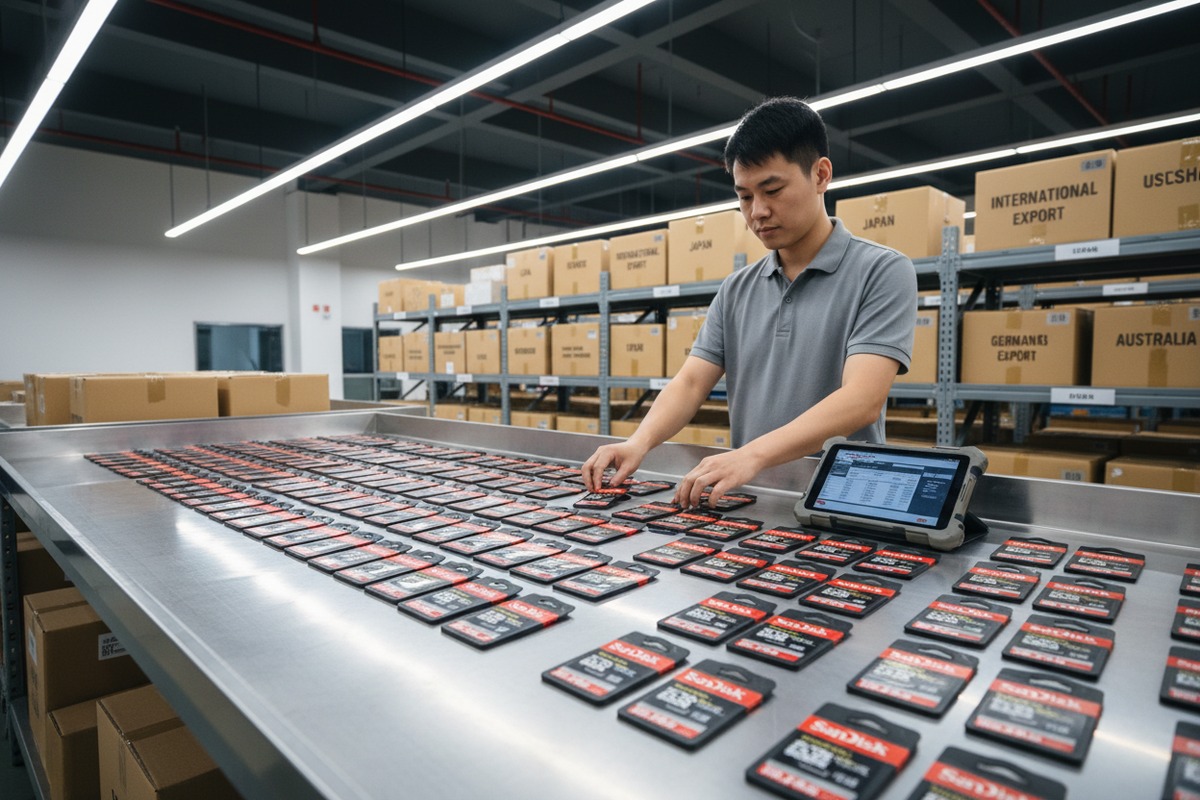
Every month, we ships thousands of SanDisk Extreme MicroSDXC cards 1 to distributors across five continents, and the single most common question we hear is deceptively simple: which capacity gives the best bang for the buck?
To compare value for money across genuine 128GB, 256GB, and 512GB SanDisk Extreme MicroSDXC cards, calculate the price per gigabyte by dividing the unit price by the capacity. Generally, the 256GB card delivers the lowest cost per GB while maintaining full A2/V30 performance, making it the sweet spot for most buyers balancing budget and storage.
Below, we break down the math, match each capacity to real-world projects, explain how to verify authenticity, and share sourcing strategies for bulk buyers A2/V30 performance 2. Let’s get into it.
When we quote prices for B2B clients in Germany, Japan, or the United States, the first number they want is not the unit cost — it is the cost per gigabyte, because that single metric cuts through marketing noise fast. price per gigabyte 3
Divide the total card price by its capacity in gigabytes. For example, a 256GB card at $45 equals roughly $0.18 per GB. Across current market data, the 256GB SanDisk Extreme consistently delivers the lowest price per gigabyte, often 40–50% cheaper per GB than the 128GB variant.

The calculation is straightforward:
Price per GB = Unit Price (USD) ÷ Capacity (GB)
You can apply this to any retailer’s listing. The key is to compare cards from the same product line and the same generation. SanDisk updates the Extreme line periodically, and older stock sometimes sells at a discount that skews the comparison if you mix generations.
Based on our latest procurement data and cross-referenced retail pricing from B&H, Amazon US, and our Hong Kong supply chain, here is a snapshot:
| Capacity | Typical Retail Price (USD) | Estimated Price per GB | Max Read Speed | Max Write Speed |
|---|---|---|---|---|
| 128GB | $28 – $37.99 | $0.21 – $0.29 | 160 – 190 MB/s | 90 MB/s |
| 256GB | $48 – $55 | $0.18 – $0.21 | 190 MB/s | 130 – 140 MB/s |
| 512GB | $107 – $127 | $0.20 – $0.24 | 190 MB/s | 130 MB/s |
A few things jump out from this table. First, the 128GB card often has the highest cost per GB. Second, the 256GB card sits in a pricing sweet spot — it is not much more expensive than the 128GB in absolute terms, yet it halves the per-GB cost in many cases. Third, the 512GB card can match or beat the 256GB on a per-GB basis, but the absolute outlay is higher, which matters when you are buying in volume.
For single-card retail buyers, 256GB almost always wins. But in our experience fulfilling bulk orders for distributors, the picture can change. When NAND flash prices 4 dip — as they did after the 2023 oversupply cycle — 512GB cards sometimes drop to near-256GB per-GB pricing. If you are purchasing 500 or 1,000 units at a time, even a $0.01 per GB difference across half a terabyte adds up significantly. We always advise our clients to request a live quote rather than relying on listed retail prices, because wholesale pricing fluctuates week to week.
Price per GB is a starting point, not the whole story. Consider shipping weight per unit, customs duties 5 by declared value, and the cost of holding inventory. A pallet of 512GB cards ties up more capital than the same unit count in 256GB cards. For a distribution business, cash flow matters as much as margin.
Our team works closely with surveillance integrators and drone fleet operators who deploy hundreds of MicroSDXC cards at a time, so we see firsthand how capacity choice impacts both project budgets and field reliability.
For 4K surveillance or drone projects, the 256GB SanDisk Extreme is the optimal balance of storage and budget in most scenarios. It holds approximately 5–6 hours of 4K footage at standard bitrates, costs less per GB than 128GB, and avoids the higher upfront investment of 512GB — though 512GB is ideal for extended recording without card swaps.
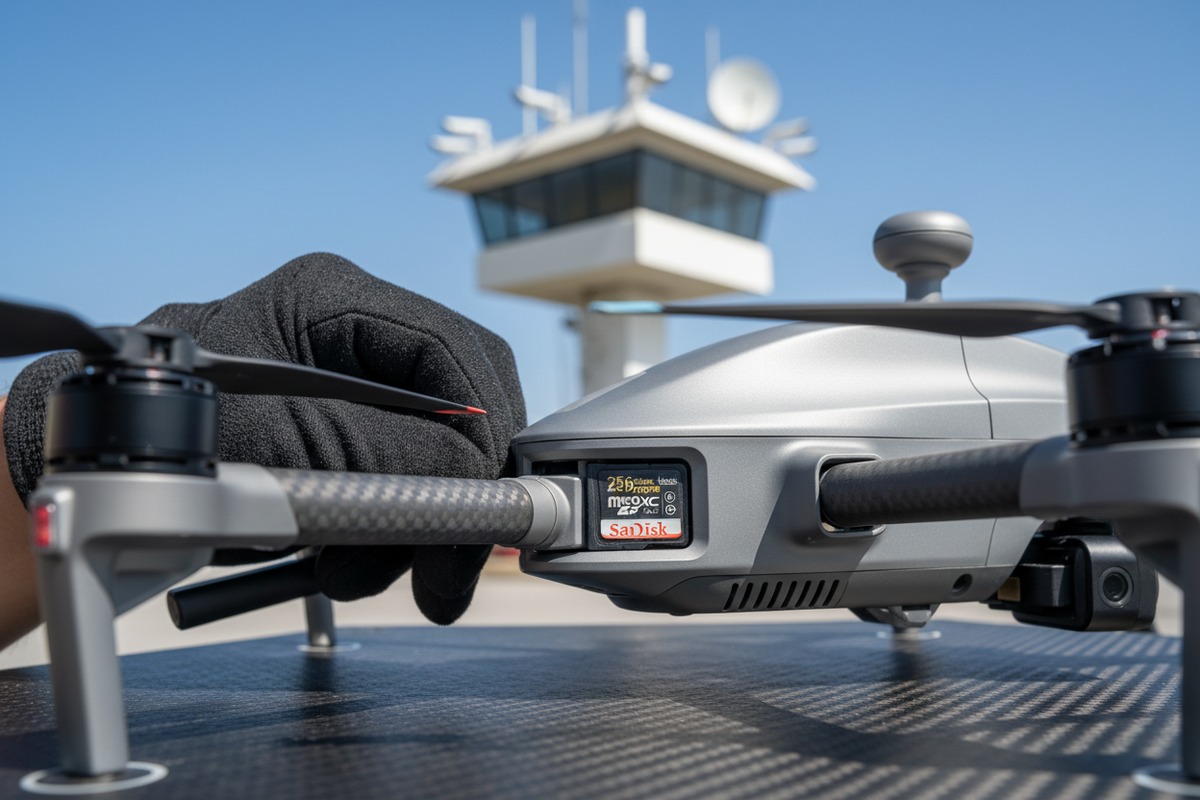
Before choosing a capacity, you need to know how fast your device fills the card. Bitrate is the key variable. A typical 4K security camera records at 15–25 Mbps. A consumer drone like the DJI Mini 4 Pro records at roughly 100–150 Mbps. These numbers translate to very different storage demands.
| Use Case | Typical Bitrate | Approx. Recording Time on 128GB | Approx. Recording Time on 256GB | Approx. Recording Time on 512GB |
|---|---|---|---|---|
| 4K Surveillance 6 (H.265, 20 Mbps) | 20 Mbps | ~14 hours | ~28 hours | ~56 hours |
| 4K Drone (H.264, 100 Mbps) | 100 Mbps | ~2.8 hours | ~5.6 hours | ~11.2 hours |
| 4K Action Camera (H.265, 60 Mbps) | 60 Mbps | ~4.7 hours | ~9.3 hours | ~18.7 hours |
In surveillance, cards are typically set to loop-record. The camera writes until the card is full, then overwrites the oldest footage. A 256GB card gives roughly 28 hours of buffer at 20 Mbps. That is more than a full day. For most installations, this buffer is sufficient for incident review before footage is overwritten. Going to 512GB doubles the buffer but also doubles the per-card cost — a tough sell when you are outfitting 50 or 100 cameras.
However, if the project requires longer retention on-card (remote sites with infrequent data retrieval), 512GB becomes essential. We have supplied 512GB Extreme cards to mining and agricultural surveillance projects across the Middle East and Africa where retrieving footage weekly is the norm.
Drone operators face a different math. Flight time is usually 25–45 minutes per battery. A 256GB card can handle multiple flights before needing to be swapped or offloaded. For a professional drone fleet running 6–8 flights per day, 256GB is sufficient if operators offload footage at lunch or between missions. If the workflow does not allow mid-day offloading, 512GB avoids data management headaches in the field.
Both surveillance and drone applications demand sustained write speeds. The V30 rating 7 guarantees a minimum sustained write of 30 MB/s, which comfortably supports 4K recording at up to 240 Mbps. The A2 rating is less critical for video recording 8 but becomes relevant if the card also runs applications — for instance, in Android-based surveillance recorders that use the card for both app storage and video.
All three capacities — 128GB, 256GB, and 512GB — carry the same V30 and A2 certifications. There is no performance penalty for choosing a smaller or larger card within the Extreme line.
For most 4K surveillance and drone projects, start with 256GB as your default. Move to 512GB only when field conditions demand extended recording without retrieval. Reserve 128GB for secondary devices, backup cards, or budget-constrained pilot deployments where you need maximum unit count within a fixed budget.
Counterfeit MicroSD cards are one of the biggest headaches in our industry. Through our quality control processes in Shenzhen and Hong Kong, we intercept suspicious batches regularly, and the sophistication of fakes has increased dramatically over the past two years.
To ensure genuine SanDisk A2 performance, purchase exclusively from authorized distributors or verified B2B suppliers with traceable supply chains. Verify the holographic label, check the serial number on SanDisk’s official website, test actual read/write speeds with tools like H2testw, and confirm the A2 app performance rating through real-world benchmarks on your target device.
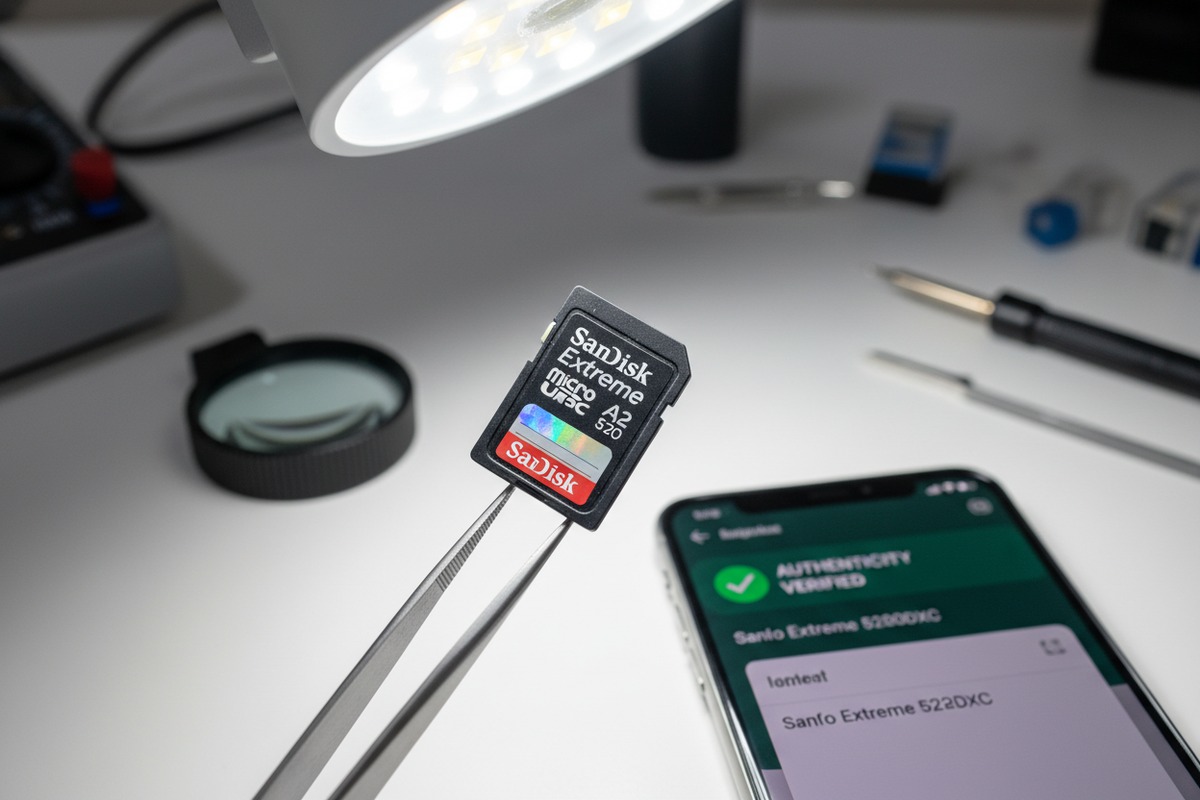
A counterfeit card does not just fail to deliver promised speeds. It can corrupt critical data, damage device firmware through voltage inconsistencies, and void equipment warranties. For a surveillance project with 100 cameras, a batch of fake cards can mean weeks of lost footage and thousands of dollars in labor to replace them. For a distribution business, a single counterfeit shipment can destroy client trust permanently.
Here is the process our QC team uses, and we recommend the same to every buyer:
The safest approach for B2B buyers is to work with suppliers who can provide full traceability. At our facilities, we maintain documentation that traces every batch back to authorized Western Digital channels. We perform random sampling for speed tests and capacity verification. This level of diligence is what separates a reliable supply partner from a marketplace gamble.
We have seen distributors source from unverified third-party Amazon sellers or grey-market brokers to save 10–15% on unit cost. The short-term savings evaporate when return rates spike, customer complaints mount, and brand reputation suffers. For any business that depends on storage reliability — whether deploying cards in drones, selling them through e-commerce, or integrating them into systems — genuine product is non-negotiable.
Genuine SanDisk Extreme cards include access to SanDisk’s partnership with Ontrack for data recovery services. This benefit is especially meaningful for larger capacities. Losing 512GB of irreplaceable drone footage is far more costly than losing 128GB. This recovery option adds tangible long-term value that counterfeit cards simply cannot offer.
When our sales team sits down with a new distributor client — whether they are based in Frankfurt, Dubai, or Tokyo — the 256GB-versus-512GB decision is always a strategic conversation, not just a pricing exercise.
When sourcing bulk 256GB versus 512GB SanDisk Extreme cards, evaluate five key factors: cost per GB at volume pricing, regional end-user demand, inventory turnover speed, counterfeit risk at each capacity tier, and your margin structure. The 256GB card typically moves faster with broader appeal, while 512GB commands higher margins but slower turnover.

Not all markets want the same capacity. In Europe and North America, consumer demand clusters around 256GB for smartphones and Nintendo Switch. Professional buyers — drone operators, surveillance integrators — lean toward 512GB. In price-sensitive emerging markets, 128GB and 256GB dominate.
Before placing a bulk order, analyze your customer base. If 70% of your revenue comes from consumer electronics retailers, stock heavier on 256GB. If you serve government surveillance tenders or commercial drone fleets, 512GB should represent a larger share.
Here is a comparison that illustrates the capital impact:
| Factor | 256GB (1,000 units) | 512GB (1,000 units) |
|---|---|---|
| Estimated Unit Cost (Wholesale) | $48 – $55 | $80 – $85 |
| Total Inventory Investment | $45,000 – $50,000 | $80,000 – $85,000 |
| Typical Retail Sell Price | $68 – $79 | $107 – $127 |
| Gross Margin per Unit | $20 – $24 | $27 – $42 |
| Average Turnover (Days) | 30 – 45 | 45 – 75 |
| Counterfeit Risk Level | Moderate | High |
The 512GB cards offer higher per-unit margins, but they tie up nearly twice the capital and take longer to sell. For a distribution business optimizing cash flow, the 256GB card’s faster turnover can generate more total profit over a quarter even with lower per-unit margins.
This is a critical point that many new distributors underestimate. The higher the capacity, the more attractive it is for counterfeiters, because the profit margin on a fake 512GB card is significantly larger than on a fake 128GB card. When sourcing 512GB in bulk, you must be even more rigorous about supply chain verification. Work only with suppliers who provide batch traceability, incoming QC reports, and are willing to support returns for verified quality issues.
Through our Shenzhen and Hong Kong operations, we perform randomized testing on every incoming 512GB batch — pulling at least 2% of units for full H2testw and speed verification. This level of QC is not optional at the 512GB tier. It is a business necessity.
The 256GB card is a volume driver. It attracts price-sensitive buyers, generates repeat orders, and serves as an entry point for new retail customers. The 512GB card is a margin driver. It appeals to professional and enthusiast segments willing to pay a premium for capacity.
A balanced distribution portfolio typically follows a ratio. For general IT accessory distributors, we recommend stocking roughly 60% in 256GB and 30% in 512GB, with 10% in 128GB for budget bundles and accessories. For distributors focused on professional AV, surveillance, or drone markets, shifting to 40% in 256GB and 50% in 512GB makes more sense.
From a logistics standpoint, MicroSD cards are small and lightweight, so shipping cost differences between capacities are negligible per unit. However, declared customs value scales with unit price. A shipment of 1,000 x 512GB cards at $50 each has a declared value of $50,000 — which may trigger different customs scrutiny thresholds than a $25,000 shipment of 256GB cards in some countries. Work with a freight forwarder experienced in electronics to manage documentation smoothly.
NAND prices continue their long-term downward trend, interrupted by periodic shortage cycles. The 512GB card is becoming more mainstream each year. If you are building a distribution business for the next three to five years, investing in 512GB inventory today positions you ahead of the curve. But manage your exposure — do not over-commit to 512GB if your current customer base is not ready to absorb it.
Choosing among 128GB, 256GB, and 512GB SanDisk Extreme MicroSDXC cards comes down to price per GB, project requirements, authenticity assurance, and smart inventory strategy — and the 256GB remains the most versatile choice for the majority of buyers.
1. Provides official product information and specifications for SanDisk Extreme microSDXC cards. ↩︎
2. Defines the technical specifications for A2 and V30 speed classes for memory cards. ↩︎
3. Explains the concept of cost per gigabyte for storage comparison. ↩︎
4. Offers a general definition and overview of NAND flash memory technology. ↩︎
5. Explains the role of customs duties in international trade. ↩︎
6. Provides insights into 4K video surveillance system considerations and market trends. ↩︎
7. Details the V30 speed class standard, ensuring minimum sustained write speeds for video. ↩︎
8. Explains technical requirements and speed classes for reliable video recording on memory cards. ↩︎
9. Provides information about the organization that sets industry-leading memory card standards. ↩︎
10. Offers a tool for verifying the actual storage capacity of memory cards and detecting counterfeits. ↩︎