Choosing the wrong Ethernet PHY variant can silently kill your product in the field IEEE 802.3 compliance 1. Fast Ethernet PHY 2 We have seen clients return entire batches of networking boards after thermal failures — all because a commercial-grade chip ended up in an industrial enclosure.
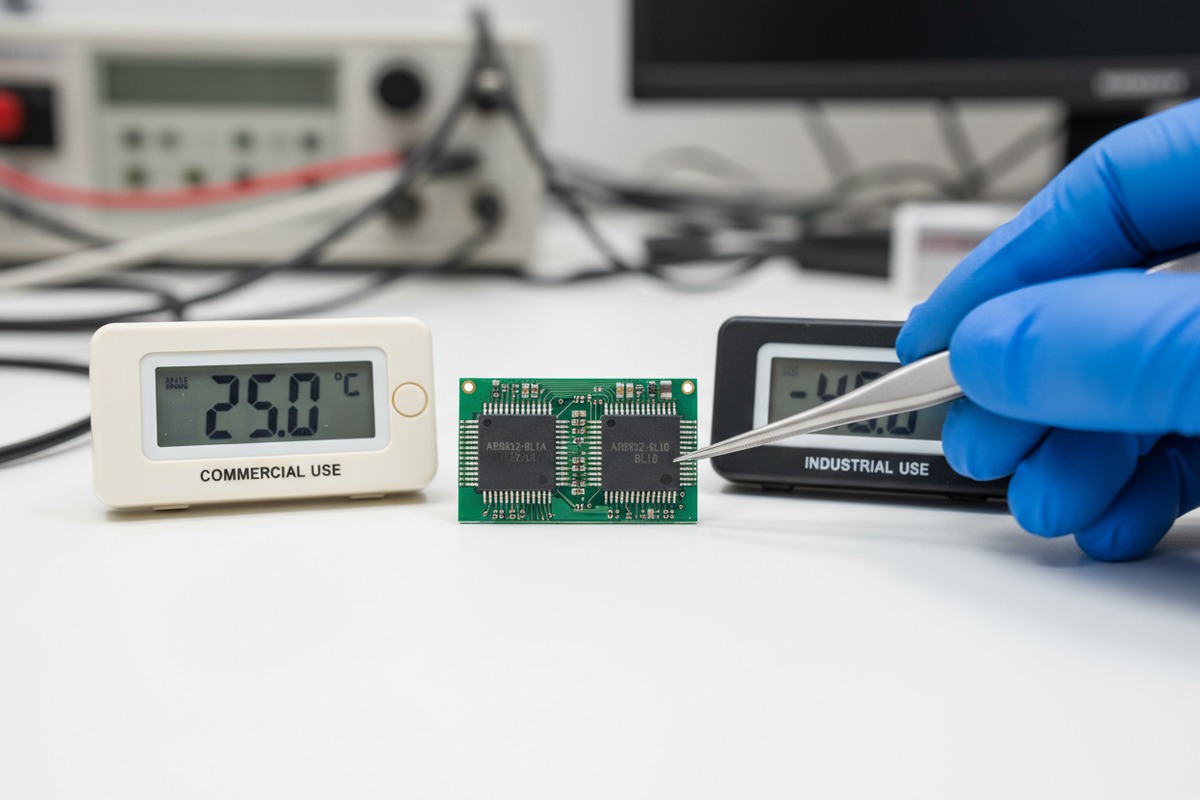
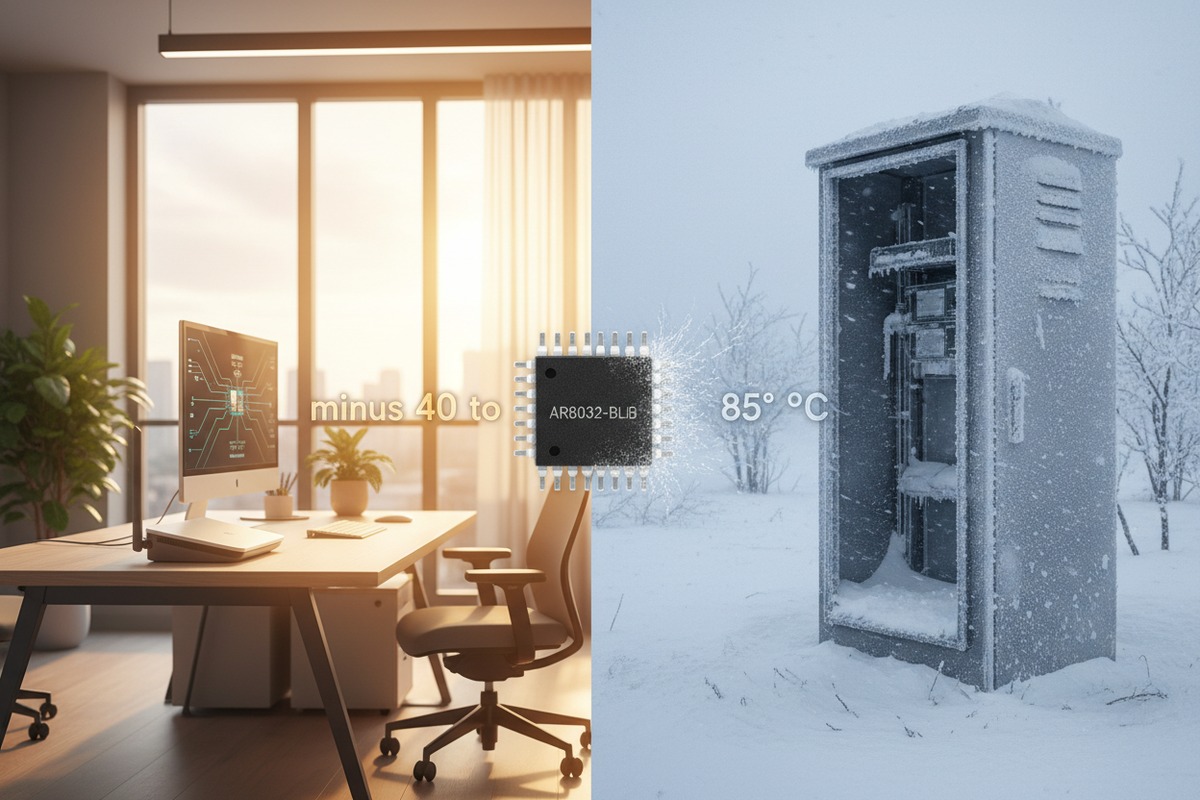
The Qualcomm AR8032-BL1A is a commercial-grade Fast Ethernet PHY rated for 0°C to 70°C ambient operation, while the AR8032-BL1B is the industrial-grade variant rated for -40°C to 85°C. Both share identical pinouts, features, and IEEE 802.3 compliance, with operating temperature being the sole differentiator.
Below, we break down every technical detail, substitution consideration, sourcing tip, and pricing factor you need to make the right choice for your next design or procurement cycle.
When our engineering team validates new IC shipments at our Shenzhen warehouse, the AR8032 variants look nearly identical on the outside operating ambient temperature 3. This creates real confusion for buyers who don't dig into the datasheet ordering information section.
The key technical difference is the operating ambient temperature range: AR8032-BL1A supports 0°C to 70°C (commercial), while AR8032-BL1B supports -40°C to 85°C (industrial). All other specifications — pinout, package, power supply, interface support, and functional blocks — are identical between the two variants.
Both the AR8032-BL1A and AR8032-BL1B are highly integrated 10/100 BASE-T/TX Ethernet transceivers. They comply with IEEE 802.3 and IEEE 802.3u standards. The internal architecture includes a digital-to-analog converter (DAC), programmable gain amplifier (PGA), automatic gain control (AGC), analog-to-digital converters (ADCs), feed-forward equalizer, and decision-feedback equalizer. These mixed-signal processing blocks handle adaptive equalization and timing recovery. This lets the chip work reliably even in noisy environments.
Both variants support MII (Media Independent Interface) with a 25 MHz external clock and RMII (Reduced MII) with a 50 MHz clock. They both include auto MDI/MDIX crossover detection, polarity correction, speed downshift, and programmable LED outputs. The Atheros Cable Diagnostic Test (CDT) feature, based on Time Domain Reflectometry (TDR) 4, is also present in both. This tool lets engineers remotely detect cable opens, shorts, and impedance mismatches.
The suffix "BL1A" or "BL1B" in the part number tells you the temperature grade. This is documented on page 53 of the AR8032 datasheet (revision 3.20). The junction temperature rating 5 is 0°C to 125°C for both parts. The difference lies in the ambient operating temperature. This matters because ambient temp affects how much thermal headroom your system has.
In practical terms, a BL1A chip can fail or behave erratically if your enclosure temperature drops below freezing or rises above 70°C. The BL1B, on the other hand, is tested and guaranteed to perform across a much wider thermal envelope.
| Specification | AR8032-BL1A | AR8032-BL1B |
|---|---|---|
| Temperature Grade | Commercial | Industrial |
| Ambient Operating Temp | 0°C to +70°C | -40°C to +85°C |
| Junction Temperature | 0°C to +125°C | 0°C to +125°C |
| Package | 32-QFN (5×5 mm) | 32-QFN (5×5 mm) |
| Supply Voltage | 3.3V single supply | 3.3V single supply |
| Ethernet Standard | IEEE 802.3, 802.3u | IEEE 802.3, 802.3u |
| Speed | 10/100 Mbps | 10/100 Mbps |
| Interface | MII / RMII | MII / RMII |
| Auto MDI/MDIX | Yes | Yes |
| Cable Diagnostics (CDT) | Yes | Yes |
| Power Saving DSP | Yes | Yes |
| Pin Count & Pinout | 32-pin, identical | 32-pin, identical |
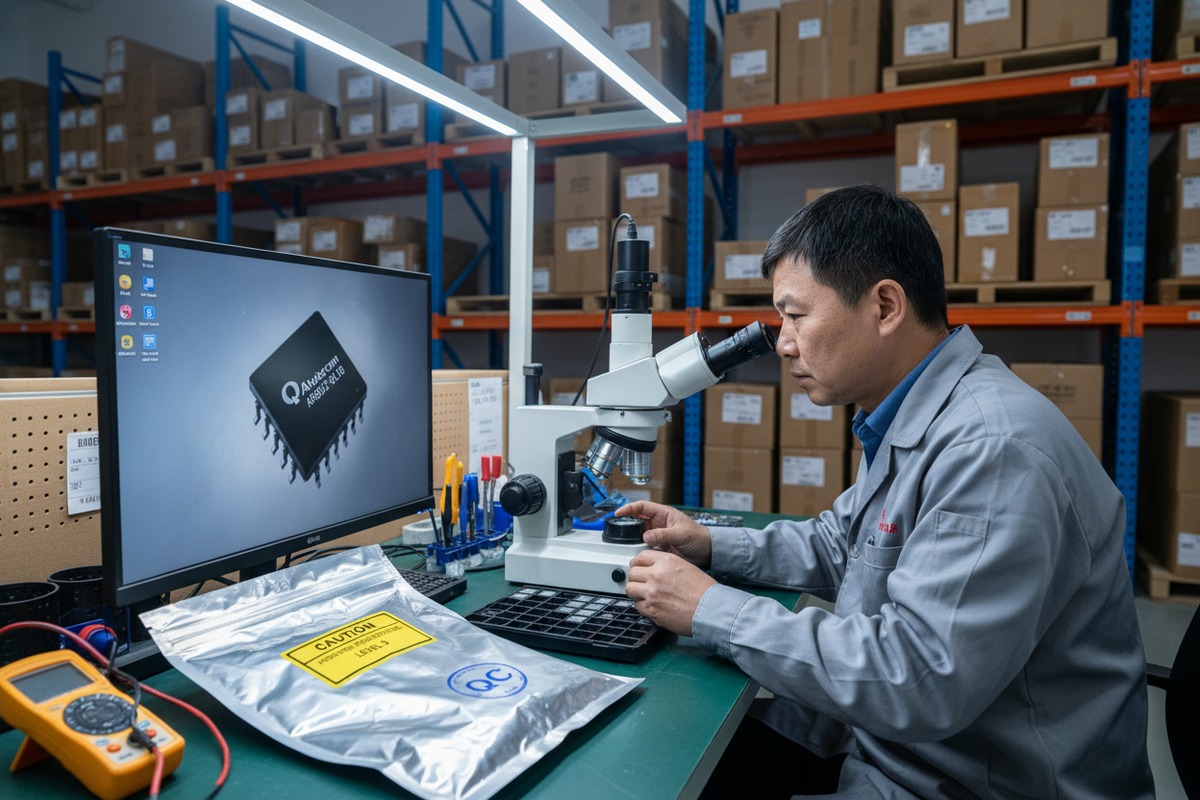
On the physical chip, the marking includes the Atheros logo, the part number, and a date code. The critical characters to check are "BL1A" versus "BL1B." Some older inventory may show faded markings. In our experience handling thousands of these units, a magnifying loupe and good lighting solve most identification issues. If markings are unclear, cross-reference the reel label. The reel label always includes the full orderable part number. Genuine packaging from Qualcomm (formerly Atheros) will have clear, laser-etched text on the IC body.
Our customers frequently ask us this question, especially when BL1A stock runs low and BL1B units are readily available. The short answer surprises many procurement managers who expect complicated trade-offs.
Yes, the AR8032-BL1B is a drop-in replacement for the AR8032-BL1A. They share identical pinouts, electrical characteristics, and functional blocks. The BL1B simply offers a wider operating temperature range, making it a superset of the BL1A with no design changes required.

Because both variants use the same 32-pin QFN package with a 5×5 mm footprint, you do not need to modify your PCB layout. The land pattern, pad dimensions, and signal routing remain the same. Power pins, ground pins, MII/RMII data pins, LED outputs, management data interface (MDIO/MDC) pins, and the analog front-end connections (TXP, TXN, RXP, RXN) all map to the same positions.
From a software perspective, the two parts are indistinguishable. The PHY ID registers return the same OUI (Organizationally Unique Identifier) 7 and model number. Linux kernel drivers, U-Boot Ethernet initialization code, and Windows NDIS drivers all treat BL1A and BL1B identically. No firmware changes, register configuration tweaks, or driver updates are needed.
There are three common scenarios where replacing BL1A with BL1B is smart:
The reverse substitution — replacing BL1B with BL1A — is risky. If your end application operates in industrial or outdoor environments, a BL1A chip may not survive thermal extremes. We have seen cases where clients in the Middle East and CIS regions deployed BL1A-based boards in outdoor telecom cabinets. Summer heat pushed ambient temperatures well above 70°C. The result was intermittent link drops and eventual PHY failure.
| Replacement Scenario | Safe? | Notes |
|---|---|---|
| BL1A → BL1B (upgrade) | ✅ Yes | BL1B is a superset; no changes needed |
| BL1B → BL1A (downgrade) | ⚠️ Risky | Only safe if ambient stays within 0–70°C |
| BL1A → BL1B in existing PCB | ✅ Yes | Same footprint, same pinout |
| BL1B → BL1A in industrial app | ❌ No | Thermal failures likely below 0°C or above 70°C |
In our daily operations shipping ICs from Shenzhen and Hong Kong warehouses, we encounter counterfeit concerns more often than most buyers realize. The AR8032, being a legacy part with steady demand, is a prime target for counterfeiters.
To source genuine AR8032-BL1B chips, buy from authorized distributors, established B2B wholesalers with traceability documentation, or directly from verified supply chain partners. Always request lot/date codes, COC (Certificate of Conformance), and check package markings against the official Qualcomm Atheros datasheet.
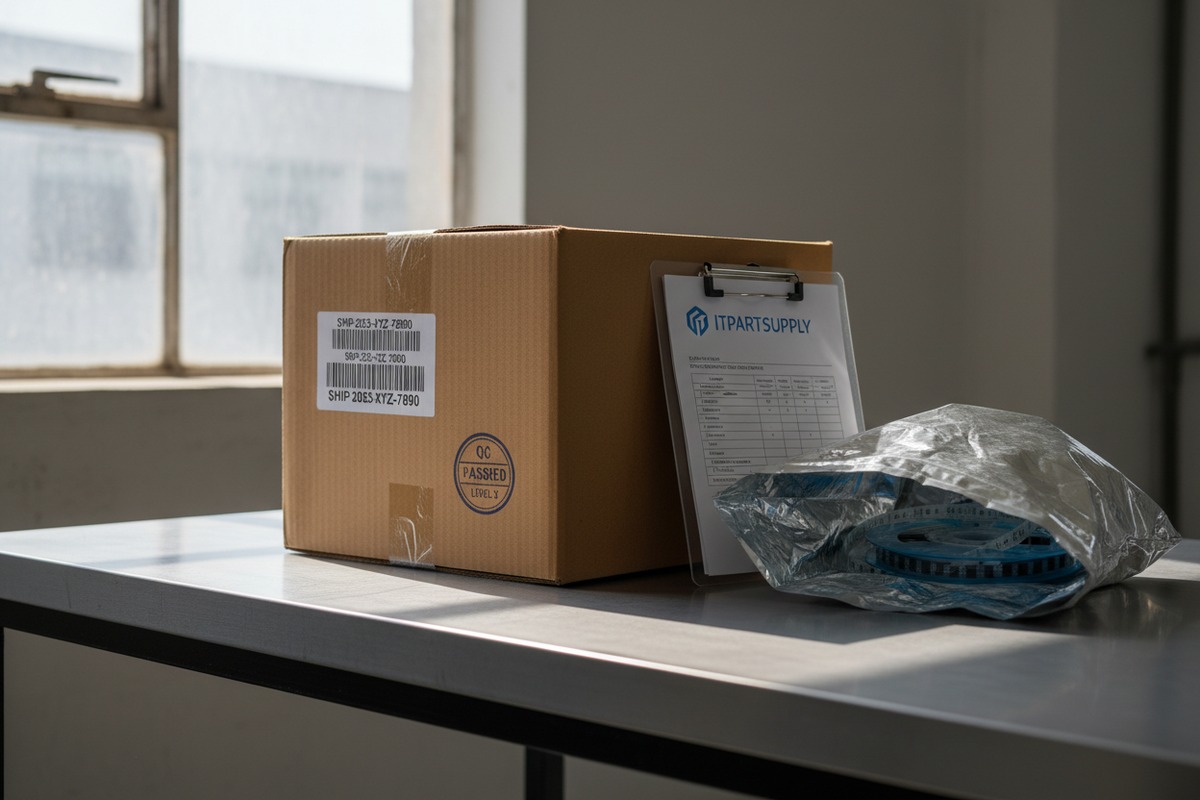
Authentic AR8032-BL1B chips come on reels inside moisture-sensitive device (MSD) bags 8. The MSD bag is a reflective, metallic silver foil material. A prominent yellow caution label on the front shows a "Level 3" moisture sensitivity rating. The reel label includes the full part number, quantity, lot code, date code, and a barcode. The shipping box is typically natural brown corrugated cardboard with a white label containing alphanumeric codes and a QR code. Some boxes also carry a blue quality control stamp.
The IC itself has a laser-etched marking on the QFN package top. Look for the Atheros logo, the "AR8032-BL1B" text, and a date code. Counterfeit parts often show:
Here is a practical checklist our quality team uses:
| Channel Type | Examples | Risk Level | Traceability |
|---|---|---|---|
| Authorized Distributor | Mouser, Digi-Key, Arrow | Low | Full |
| Verified B2B Wholesaler | ITPARTSUPPLY, established Shenzhen traders | Low–Medium | Lot codes + COC available |
| Broker / Spot Market | Independent brokers | Medium–High | Varies; always verify |
| Online Marketplace | eBay, AliExpress, Taobao | High | Minimal or none |
| Recycled / Pulled Parts | Refurbishment shops | Very High | None |
When sourcing from our Shenzhen and Hong Kong facilities, we provide original packaging with intact MSD bags, reel labels, and shipping cartons. We also offer COC documentation and can facilitate third-party testing if required. For buyers in the Middle East, Southeast Asia, and Europe, we ship via DHL and FedEx with full customs-compliant documentation.
The AR8032 was originally designed by Atheros Communications, which Qualcomm acquired in 2011. Since then, the part has not seen major revisions. The latest known datasheet is revision 3.20. This means active production may be winding down. As a result, channel inventory becomes the primary source. The risk of counterfeits rises when OEM production slows and demand persists. Buyers should plan ahead, secure buffer stock, and maintain relationships with trusted suppliers.
When we quote AR8032 variants to our B2B customers, the pricing question always comes up early. Project managers and procurement leads need to understand not just the unit cost but the total cost of ownership 9.
The AR8032-BL1B (industrial) typically costs 10% to 30% more per unit than the AR8032-BL1A (commercial) due to its extended temperature testing and qualification. However, bulk purchasing, multi-source quoting, and avoiding field failures can offset or eliminate this premium in total project cost.
Several factors affect the per-unit price of each variant:
The unit price tells only part of the story. Consider these hidden costs:
Field failure costs. If you use BL1A in an application that occasionally exceeds 70°C, you risk field failures. Each failure costs you in warranty replacements, shipping, technician labor, and reputation damage. One field failure can easily cost $50–$200 or more per unit, far exceeding the $0.20–$0.50 premium for BL1B.
Inventory simplification. If you stock only BL1B, you eliminate the need to manage two SKUs. This reduces warehousing complexity, picking errors, and minimum order quantity challenges.
Design requalification. If you initially design with BL1A and later need to upgrade to BL1B for a new market (say, outdoor deployments), you may need to re-run compliance testing. This cost can be avoided by starting with BL1B.
| Cost Factor | AR8032-BL1A | AR8032-BL1B | Impact |
|---|---|---|---|
| Unit price (small qty, 1–100) | Lower (baseline) | 10–30% higher | Small per-unit difference |
| Unit price (bulk, 1000+) | Discounted | Discounted (gap narrows) | Bulk pricing reduces the premium |
| Testing & qualification cost | Standard | Higher (wider temp screening) | Built into unit price |
| Field failure risk (industrial use) | High | Very low | BL1B saves warranty costs |
| Inventory management (dual SKU) | Added complexity | Simplified (single SKU) | Operational savings with BL1B |
| Requalification for new markets | Possible cost | Avoided | BL1B covers both use cases |
For projects with volumes under 500 units, the price difference between BL1A and BL1B is often negligible in the context of total BOM cost. A networking board might have a BOM of $15–$50. The PHY is a small fraction of that. Spending an extra $0.30 on the industrial variant is excellent insurance.
For high-volume projects (10,000+ units), negotiate directly with wholesalers. At our facility, we offer tiered pricing for both variants. We also provide sample units for qualification testing before large orders. This lets procurement managers validate the part before committing budget.
One more consideration: as the AR8032 ages and potentially reaches end-of-life, securing stock early locks in better pricing. Waiting until last-time-buy announcements often results in price spikes and scramble for allocation. Planning ahead is the smartest cost strategy for any legacy PHY.
The AR8032-BL1A and AR8032-BL1B differ only in ambient temperature rating. Choose BL1B for industrial reliability, verify sourcing carefully, and consider total cost — not just unit price.
1. Provides an overview of the IEEE standard for wired Ethernet. ↩︎
2. Explains the networking technology and its physical layer components. ↩︎
3. Defines the allowable temperature range for electronic device operation. ↩︎
4. Authoritative and comprehensive explanation of TDR. ↩︎
5. Defines the maximum operating temperature of a semiconductor’s actual die. ↩︎
6. Describes the Quad Flat No-leads (QFN) package type used for ICs. ↩︎
7. Explains the unique 24-bit identifier assigned by IEEE to organizations. ↩︎
8. Describes packaging for electronic components susceptible to moisture damage. ↩︎
9. Authoritative and comprehensive explanation of Total Cost of Ownership. ↩︎