Direct Answer: Middle East AI data center growth is increasing demand for enterprise storage hardware, especially high-capacity HDDs for datasets, backup, archival, object storage, logs, model checkpoints, and cost-efficient capacity layers. B2B buyers should verify workload fit, model consistency, firmware, sector format, packaging, lead time, and supply continuity before placing bulk orders.
The Middle East is becoming one of the most active regions for AI infrastructure, cloud expansion, sovereign data platforms, and large-scale data center investment. For IT distributors, system integrators, server resellers, and data center procurement teams, this creates a practical question:
How should buyers source the right enterprise storage hardware before demand becomes urgent?
According to Gartner, IT spending in the Middle East and North Africa is projected to reach approximately $169 billion in 2026, with data center systems among the fastest-growing segments. G42 has also announced Stargate UAE as part of a large AI infrastructure campus in Abu Dhabi, while Saudi Arabia’s HUMAIN initiative has been reported as building new data center capacity in Riyadh and Dammam. These projects show a clear market signal: AI infrastructure in the region is no longer only a strategy topic. It is becoming a hardware procurement topic.
For B2B buyers, the opportunity is not simply that AI is growing. The real opportunity is understanding what storage hardware is needed, where enterprise HDDs fit, how to avoid mismatched drives, and how to secure model-consistent supply before project deadlines become tight.
At ITPartSupply, we work with B2B buyers who source enterprise HDDs, enterprise SSDs, memory, server storage, and selected server components for distribution, system integration, and project-based deployment. This guide explains how Middle East AI data center growth affects storage sourcing, what buyers should check before placing bulk HDD orders, and how to reduce risk when planning enterprise storage procurement.
Middle East governments and technology groups are investing heavily in AI infrastructure, cloud platforms, smart city systems, sovereign data centers, and high-performance computing environments. This matters to storage buyers because every AI project creates a data problem before it creates a hardware order.
AI systems need datasets. Datasets need storage. Training environments need fast access to selected data. Inference systems generate logs and outputs. Backup systems preserve model checkpoints. Compliance teams require retention. Data center operators need scalable, cost-efficient capacity.
This is where enterprise storage procurement becomes strategic. A buyer who waits until the final project stage may face limited stock, changing prices, inconsistent models, or longer lead times. A buyer who plans early can define the storage tier, confirm compatible models, and secure supply in phases.
For Middle East projects, this is especially important because many deployments are large, fast-moving, and tied to public-sector, telecom, cloud, smart city, or system integration schedules.
Q: Why does AI infrastructure growth create storage demand?
A: AI projects require large amounts of data for training, testing, inference, backup, and compliance retention. Even when GPUs and networking receive most of the attention, storage remains a critical layer behind the system.
Q: Are enterprise HDDs used directly for AI training?
A: Usually not as the highest-performance layer. NVMe SSDs and enterprise SSDs often handle hot data and latency-sensitive workloads, while enterprise HDDs support large-scale dataset storage, backup, archival, object storage, and cost-efficient capacity expansion.
Q: Why is the Middle East important for B2B storage suppliers?
A: The region is investing in AI, cloud, smart city, data center, and sovereign infrastructure projects. These projects require ongoing hardware sourcing, not just one-time purchases.
In AI infrastructure procurement, storage is not a background detail. It is the layer that decides whether data can be stored, protected, expanded, and recovered at scale.
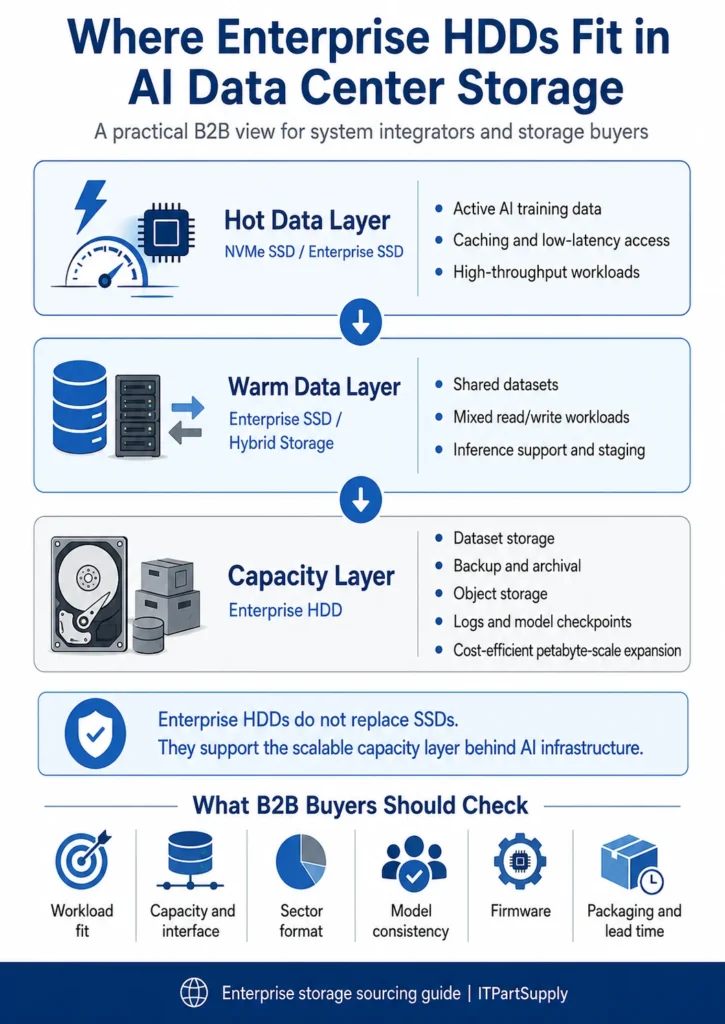
A common mistake is assuming that every AI workload needs only the fastest storage. In reality, AI data centers usually use multiple storage layers. Each layer has a different job.
Hot data may need NVMe SSDs or high-performance enterprise SSDs. Warm data may use enterprise SSDs or hybrid storage. Large datasets, backups, model checkpoints, logs, compliance archives, and cold storage can often be supported by high-capacity enterprise HDDs.
This makes enterprise HDDs important not because they replace SSDs, but because they lower the cost per terabyte for large-scale capacity. For many AI infrastructure projects, the storage architecture is not “HDD versus SSD.” It is “which workload belongs on which tier?”
For example, a training cluster may use NVMe SSDs for active data pipelines, while enterprise HDDs store raw datasets, historical data, checkpoints, and backup copies. A smart city platform may use SSDs for real-time processing but enterprise HDDs for long-term image, video, sensor, or log storage.
Q: Should AI data centers use HDDs or SSDs?
A: They usually use both. SSDs are better for high-speed access, while enterprise HDDs are useful for high-capacity, cost-efficient storage layers.
Q: What is the main role of enterprise HDDs in AI infrastructure?
A: Enterprise HDDs are commonly used for dataset storage, archival, backup, object storage, log retention, and petabyte-scale capacity expansion.
Q: Can surveillance HDDs replace enterprise HDDs?
A: Not always. Surveillance HDDs are optimized for continuous video recording, while enterprise HDDs are designed for data center workloads, higher workload ratings, dense rack environments, and enterprise reliability expectations.
The question is not whether HDD or SSD is better. The better question is which storage tier your project actually needs.
Enterprise HDD sourcing is not only about asking for the best price. A serious B2B buyer should check technical fit, supply quality, and deployment risk before confirming a large order.
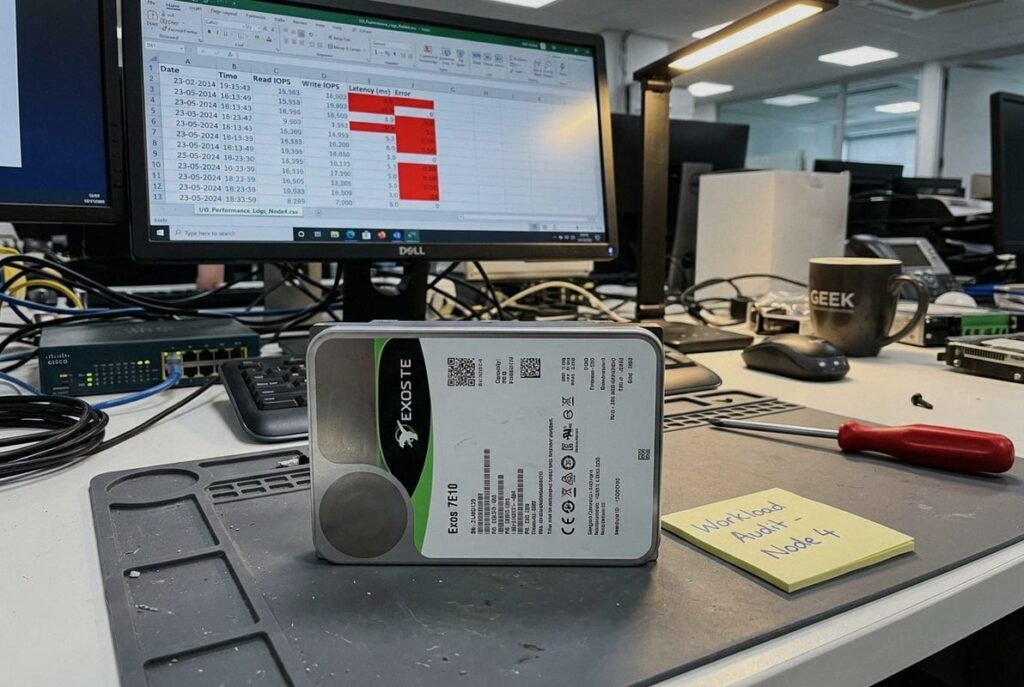
The most important checks include capacity, interface, sector format, workload rating, MTBF, RPM, cache, warranty, firmware, manufacturing date, condition, packaging, and lead time. If the order is for a data center or system integration project, the buyer should also check whether the drives are compatible with the server platform, RAID controller, storage enclosure, and operating environment.
Capacity alone is not enough. A 20TB HDD can be unsuitable if it has the wrong interface. A correct-capacity SAS drive will not work in a SATA-only system. A 4Kn sector format may cause compatibility problems in older infrastructure. A mixed-firmware batch may create unpredictable RAID behavior.
Before requesting a quote, the buyer should prepare a clear RFQ. This saves time, avoids wrong offers, and helps the supplier suggest alternatives when the exact model is limited.
Q: What information should I include in an enterprise HDD RFQ?
A: Include model number, capacity, interface, quantity, condition requirement, warranty expectation, destination country, application, and delivery timeline.
Q: Why is sector format important?
A: Some systems support 512e, while others require 4Kn or 512n. Choosing the wrong sector format can cause compatibility issues with older RAID controllers or operating systems.
Q: Why does firmware matter in bulk HDD orders?
A: Mixed firmware can create inconsistent behavior in RAID arrays or storage systems. For large deployments, buyers should request model and firmware consistency when possible.
A good RFQ does not only help the supplier quote faster. It protects the buyer from receiving the wrong product.
For AI infrastructure, cloud storage, backup, archival, and enterprise data center projects, buyers commonly ask for high-capacity HDDs because rack space, power, cooling, and cost per terabyte all matter.
Typical demand often focuses on 12TB, 14TB, 16TB, 18TB, 20TB, 22TB, and 24TB enterprise HDDs. Some buyers may also evaluate 26TB, 28TB, or 30TB models depending on availability, budget, and compatibility. However, the newest capacity is not always the best choice for every project.
In B2B procurement, mature high-capacity models may offer better availability, easier replacement, and more predictable pricing. For phased deployments, the buyer should ask whether the same model can be supplied again in the next batch. If the project requires 500 drives now and 800 drives later, model continuity may matter more than chasing the newest capacity.
Q: Which HDD capacities are most common for data center storage?
A: Many buyers focus on 12TB to 24TB enterprise HDDs, depending on system compatibility, budget, and project scale.
Q: Should I always choose the highest capacity available?
A: Not always. Higher capacity can reduce cost per terabyte and rack density, but buyers must check compatibility, lead time, price stability, and future availability.
Q: Why do buyers ask for the same model across multiple batches?
A: Model consistency helps maintain predictable RAID behavior, simplifies replacement, and reduces compatibility risk in multi-phase deployments.
In enterprise storage, the best model is not always the newest model. It is the model that fits the workload, budget, system, and supply plan.
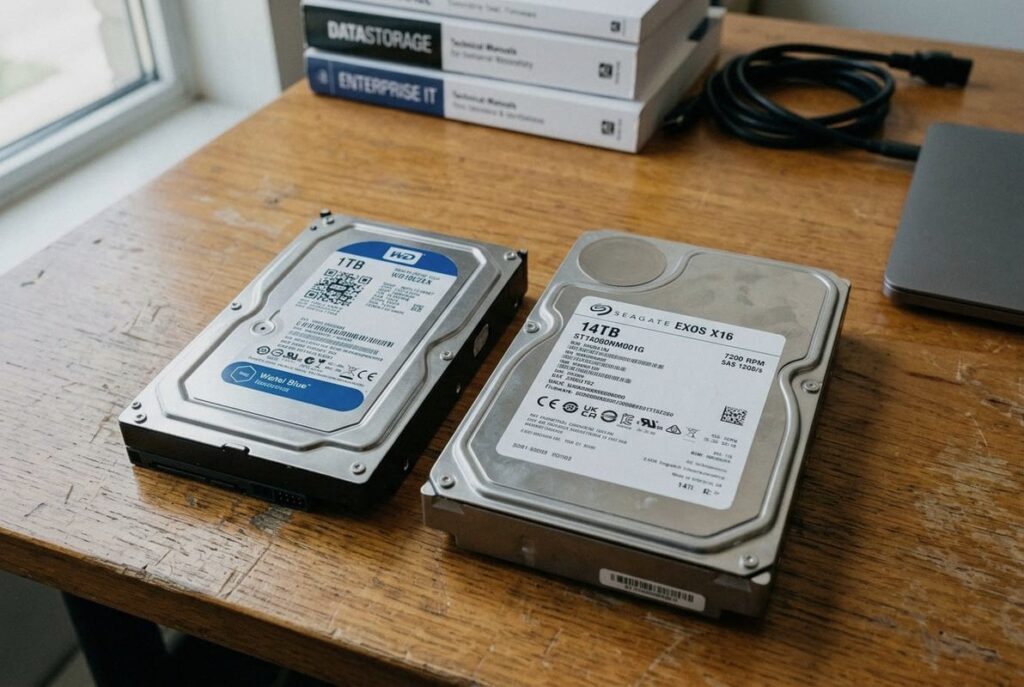
Enterprise HDDs, NAS HDDs, and surveillance HDDs may look similar from the outside, but they are designed for different workloads.
Enterprise HDDs are built for servers, storage arrays, data centers, and high-duty-cycle environments. They usually emphasize workload rating, MTBF, vibration tolerance, RAID behavior, and sustained operation.
NAS HDDs are designed for multi-bay network storage, file sharing, backup, and small to medium business storage. They can be suitable for many storage environments, but they are not always the right choice for dense enterprise arrays or heavy data center workloads.
Surveillance HDDs are optimized for continuous video recording. They are useful for CCTV, NVR, and security systems, especially when sequential writing is the main workload. However, they should not automatically be used for AI, cloud, or enterprise mixed read-write environments unless the workload truly matches.
Q: Can NAS HDDs be used in enterprise storage projects?
A: Sometimes, but it depends on workload, bay count, workload rating, warranty, and compatibility. For data center storage arrays, enterprise HDDs are usually the safer choice.
Q: Are surveillance HDDs good for AI data centers?
A: Usually they are not the first choice for mixed enterprise workloads. Surveillance HDDs are optimized for sequential video recording, not general data center read-write operations.
Q: What is the safest choice for bulk data center storage?
A: Enterprise-grade HDDs are usually preferred because they are designed for 24/7 operation, dense racks, higher workload ratings, and enterprise storage systems.
| Storage Type | Best Fit | Typical Strength | Key Risk |
|---|---|---|---|
| Enterprise HDD | Data center capacity layer | High capacity, lower cost per TB | Wrong firmware or sector format |
| Enterprise SSD | Mixed enterprise workloads | Higher speed than HDD | Higher cost per TB |
| NVMe SSD | Hot data, cache, training access | Low latency, high throughput | Cost and thermal planning |
| NAS HDD | File sharing, backup, NAS systems | Good SMB storage balance | May not fit dense data center workloads |
| Surveillance HDD | CCTV and NVR video recording | 24/7 sequential write support | Not ideal for mixed workloads |
Typical applications only. Always verify the official datasheet, system compatibility list, and actual workload before procurement.
A cheaper drive becomes expensive when it fails in the wrong environment.
Large storage projects rarely fail because one drive is unavailable. They fail because the buyer cannot get the right model, in the right quantity, with the right consistency, at the right time.
Bulk sourcing risk becomes serious when projects require hundreds or thousands of drives. If a buyer receives mixed models, mixed firmware, different sector formats, or inconsistent conditions, the problem may only appear during deployment. By then, the cost is no longer just the drive price. It becomes labor cost, project delay, customer dissatisfaction, and possible contract risk.
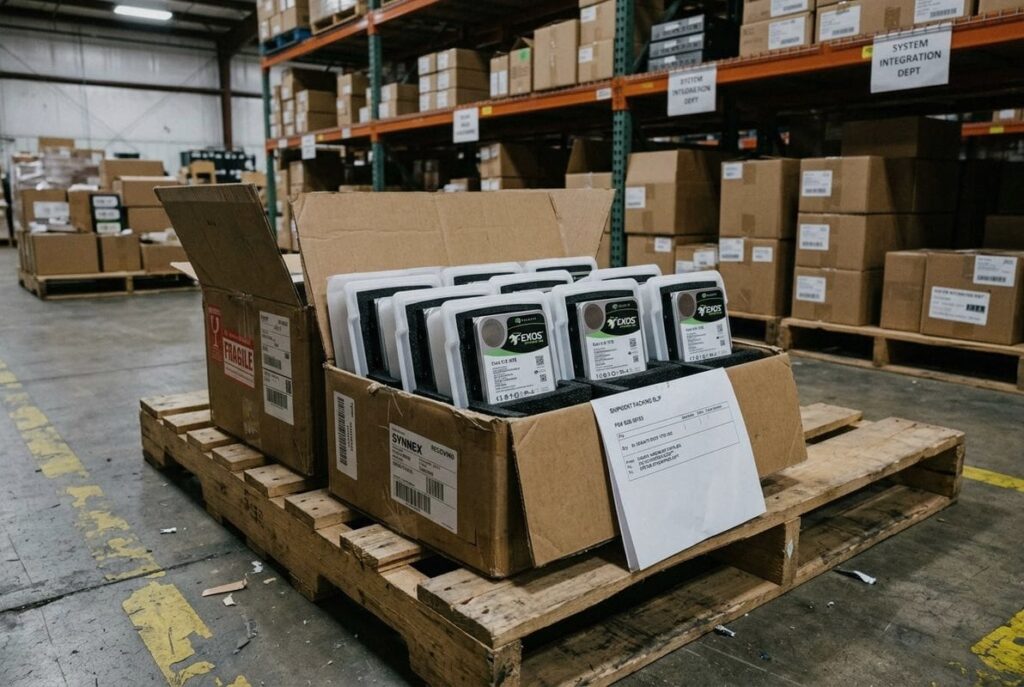
For Middle East projects, logistics also matters. Drives must be packed correctly, protected against shock, labeled clearly, and shipped with documentation suitable for customs and receiving teams. A small packaging mistake can create DOA risk and delay installation.
A professional B2B supplier should not simply say “stock available.” The supplier should help confirm model details, batch consistency, packaging, delivery schedule, and realistic lead time.
Q: What is the biggest sourcing risk in bulk HDD orders?
A: The biggest risk is receiving drives that match capacity but do not match model, firmware, interface, sector format, condition, or deployment requirements.
Q: Why does packaging matter for HDD shipments?
A: HDDs are sensitive to shock and handling damage. Proper anti-static packaging, foam protection, carton labeling, and export handling reduce DOA risk.
Q: Should buyers accept mixed models in one order?
A: For non-critical storage, it may be acceptable in some cases. For RAID arrays, data center systems, and phased projects, model consistency is usually preferred.
In bulk storage sourcing, “available” is not enough. The real question is whether the available stock is consistent, compatible, and ready to deploy.
A strong RFQ helps both sides. The buyer receives a more accurate quote, and the supplier can avoid sending irrelevant options.
For system integrators, the RFQ should start with the application. Is the storage for AI dataset archive, cloud backup, surveillance recording, object storage, enterprise NAS, server expansion, or RAID replacement? After the application is clear, the buyer should specify capacity, interface, quantity, condition, preferred brands, warranty expectation, and delivery location.
If the buyer already has a target model, the RFQ should include the exact model number. If the model is flexible, the buyer should say which specifications are fixed and which can be substituted. For example, “18TB SATA enterprise HDD is acceptable, Seagate Exos or WD Ultrastar preferred, same model batch required, destination Dubai.”
This level of clarity helps the supplier check stock faster and propose realistic alternatives when the exact model is limited.
Q: What should I write in an RFQ for enterprise HDDs?
A: Include application, model number, capacity, interface, quantity, condition, warranty expectation, delivery country, and required lead time.
Q: Should I mention the application even if I know the model?
A: Yes. Application helps the supplier identify potential risks and suggest alternatives if the requested model is unavailable.
Q: Can I ask for alternative models?
A: Yes. Buyers should clearly state whether alternatives are acceptable and which specifications must remain fixed.
The more precise the RFQ, the faster the quote and the lower the risk of receiving the wrong product.
For B2B buyers, enterprise storage sourcing is not only a purchasing task. It is a risk-control process. IT distributors, system integrators, and server parts suppliers need a sourcing partner who understands both product specifications and project urgency.
ITPartSupply supports buyers by helping check target models, confirm basic specifications, compare alternative options, verify availability, and prepare suitable supply suggestions for enterprise HDDs, enterprise SSDs, memory, server parts, and selected IT hardware categories.
We do not recommend choosing hardware only by the lowest unit price. For serious storage projects, buyers should consider compatibility, workload fit, model consistency, warranty expectation, packaging, and lead time. A slightly cheaper drive can become expensive if it causes deployment delays or compatibility problems.
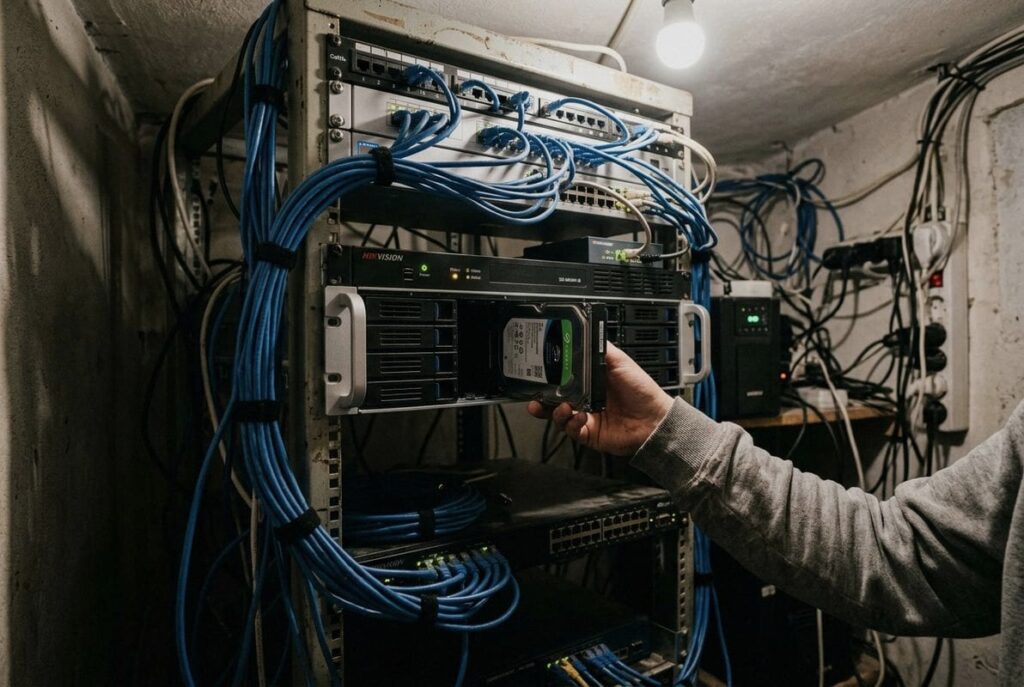
For Middle East buyers working on AI, cloud, smart city, surveillance, or data center projects, a practical sourcing process should begin before the final installation deadline. Early communication gives both buyer and supplier more room to check stock, compare models, and arrange phased delivery.
Q: What type of buyers does ITPartSupply support?
A: ITPartSupply mainly supports B2B buyers such as IT distributors, system integrators, server parts suppliers, data center procurement teams, and project-based hardware buyers.
Q: What products can buyers ask about?
A: Buyers can ask about enterprise HDDs, enterprise SSDs, server storage, memory, selected server parts, and related IT hardware sourcing needs.
Q: What information should I send before requesting a quote?
A: Send your target model, capacity, quantity, application, condition requirement, warranty expectation, delivery destination, and required lead time.
Middle East AI infrastructure growth is creating a practical opportunity for enterprise storage suppliers, IT distributors, system integrators, and data center hardware buyers. The opportunity is not only in GPUs, servers, and networking. It is also in the storage layer that supports datasets, backups, archives, object storage, logs, model checkpoints, and long-term capacity expansion.
Enterprise HDDs remain important because they provide scalable capacity at a lower cost per terabyte than SSD-based storage. However, they must be used correctly. Buyers should not treat all high-capacity drives as interchangeable. Workload rating, interface, sector format, firmware, compatibility, model consistency, packaging, and supply continuity all matter.
If you are sourcing enterprise HDDs, enterprise SSDs, or server storage hardware for a Middle East data center, AI infrastructure, cloud, backup, or system integration project, send us your target model, capacity, quantity, application, destination, and required lead time. ITPartSupply can help you check suitable options and prepare a B2B sourcing plan based on your real project needs.
Last updated: July 07, 2026
Author: ITPartSupply Storage Sourcing Team
Reviewers: Product Sourcing Team; Technical Sales Team