
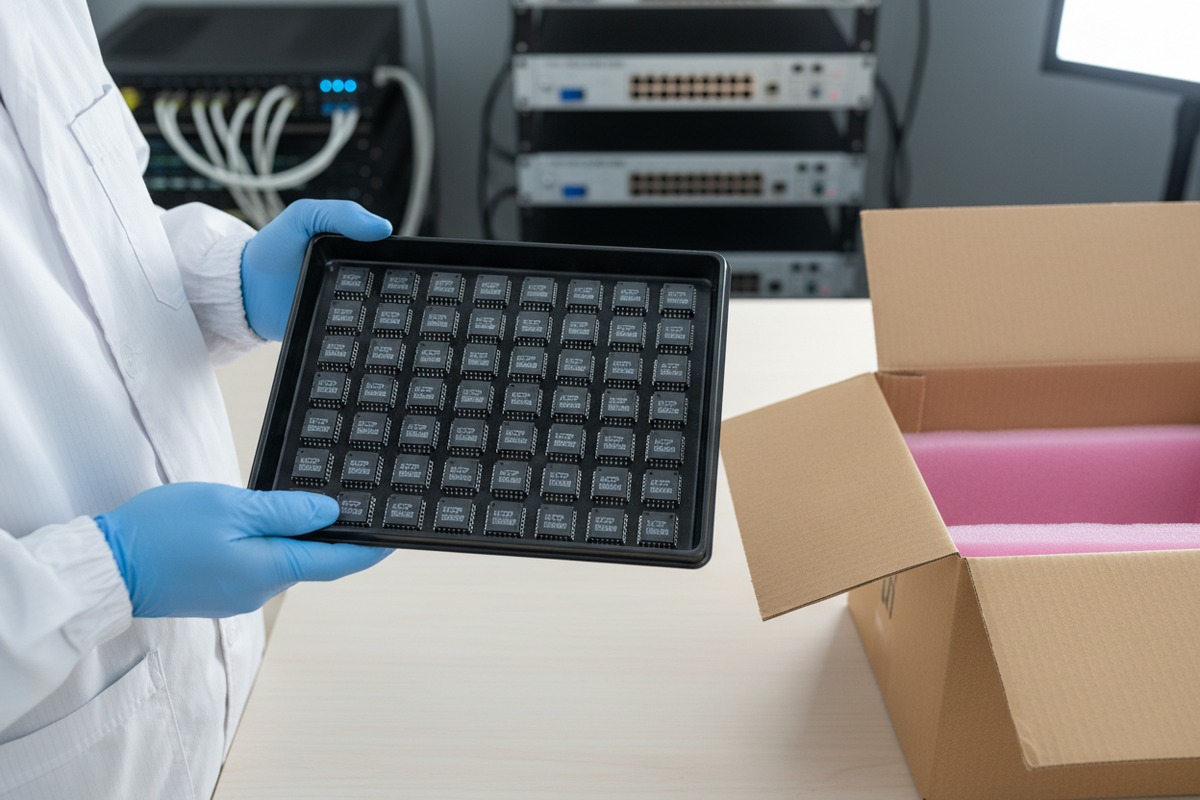
Every month in our APAC |Hongkong warehouse , we ship thousands of Ethernet PHY components 1 to network equipment builders worldwide who face relentless pressure to increase port density while cutting power and board space.
The VSC8504XKS-02 is a quad-port Gigabit Ethernet PHY transceiver from Microchip Technology, primarily applied in enterprise network switches, data center fanout equipment, telecommunications backhaul systems with SyncE timing, industrial automation gateways, and OEM/ODM hardware platforms requiring high port density and energy efficiency.
Below, we break down the four most common application areas where this transceiver delivers real value QSGMII MAC interface 2. Whether you are designing switches, building IoT gateways, running telecom infrastructure, or manufacturing hardware at scale, this guide will help you understand exactly where the VSC8504XKS-02 fits.
When we fulfill orders for switch manufacturers in Germany and Japan, the most frequent request we hear is for PHY chips that pack maximum ports into minimum board space without sacrificing Gigabit performance or thermal headroom IEEE 802.3az standard 3.
Yes, the VSC8504XKS-02 integrates seamlessly into high-density enterprise switches. Its quad-port design with QSGMII MAC interface consolidates four Gigabit PHYs into one compact package, dramatically reducing PCB area, BOM cost, and power consumption compared to discrete single-port alternatives.
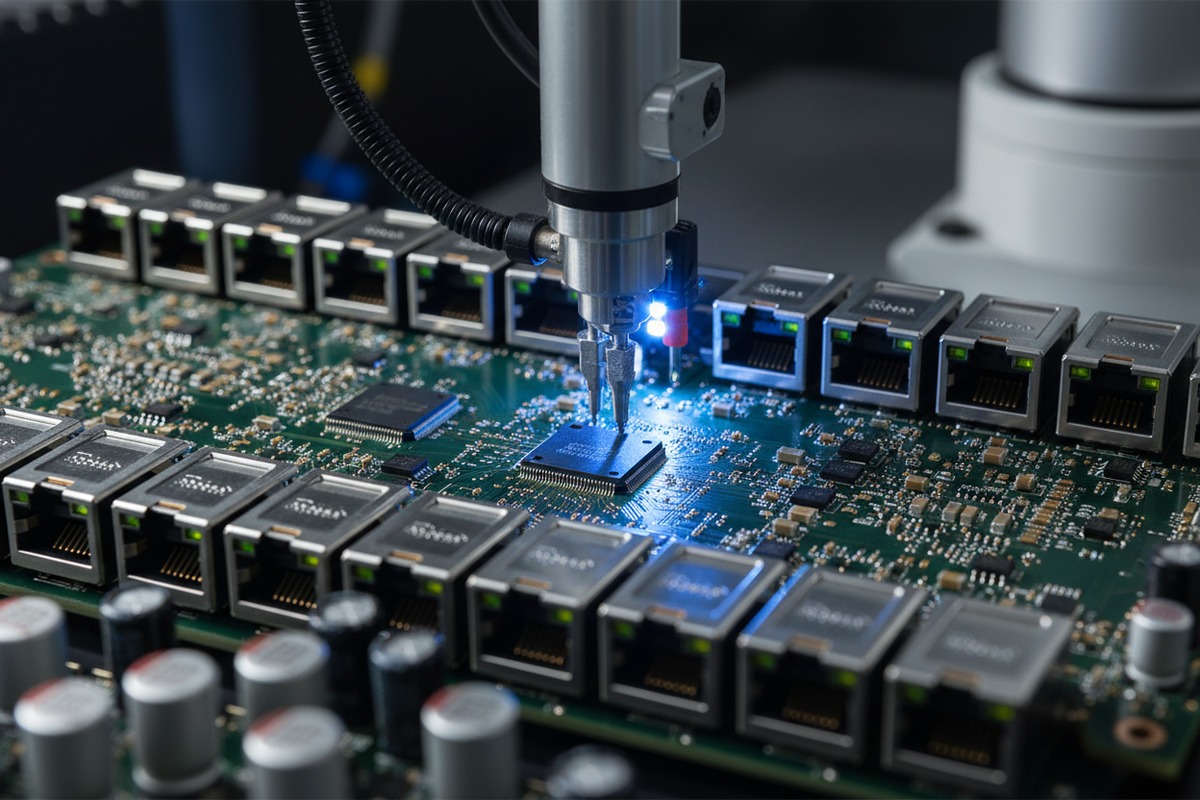
Enterprise network switches 4 commonly need 24 or 48 copper Gigabit ports on a single board. If you use a single-port PHY for each, you need 48 individual chips. That means 48 separate footprints, 48 sets of decoupling capacitors, and a nightmare of PCB routing. The VSC8504XKS-02 changes that equation. With four independent PHYs per package, a 48-port switch needs only 12 of these chips. Board area shrinks. Routing simplifies. Assembly costs drop.
The QSGMII (Quad Serial Gigabit Media Independent Interface) is a critical feature. It carries all four ports’ data over a single high-speed serial link to the MAC or switch ASIC. This reduces the number of traces between the PHY and the switch chip from dozens (in RGMII or SGMII configurations) to just a handful. For hardware engineers, this translates into fewer PCB layers, shorter design cycles, and better signal integrity.
Enterprise environments often have hundreds or thousands of switch ports. Not every port is active at full load around the clock. The VSC8504XKS-02 supports Energy Efficient Ethernet (EEE) 5 under the IEEE 802.3az standard and Microchip’s proprietary EcoEthernet technology. During low-traffic periods, these features can reduce per-port power consumption by up to 50–70%, according to Microchip’s published data. Over a campus network with thousands of ports, the cumulative energy savings are significant.
Some enterprise switches need both copper RJ45 and SFP fiber uplinks on the same platform. The VSC8504XKS-02 supports dual-media operation on each port — copper and fiber — giving switch designers the flexibility to offer combo ports without adding separate fiber PHY chips.
| Feature | VSC8504XKS-02 (Quad) | Typical Single-Port PHY | Benefit |
|---|---|---|---|
| Ports per package | 4 | 1 | 4x density improvement |
| MAC interface | QSGMII | RGMII / SGMII | Fewer PCB traces |
| EEE support | Yes (802.3az) | Varies | Lower idle power |
| Dual-media (Cu/Fiber) | Yes | Rarely | Combo port support |
| Typical board area per port | ~25% of discrete | Baseline | Major PCB savings |
It is fair to mention alternatives. Broadcom’s BCM54640S and Marvell’s 88E1680 also target high-density switches. Broadcom often leads in raw throughput for data center spine switches. Marvell excels in integrated switch-PHY SoC solutions. However, the VSC8504XKS-02 holds a strong edge when SyncE timing and EcoEthernet efficiency are both required in the same design. For mid-tier enterprise switches — 24 to 48 ports — it strikes an excellent balance between cost, features, and integration ease.
Our engineering support team regularly works with factory automation companies in the EU and Japan who need ruggedized Ethernet connectivity in compact gateway enclosures — and the choice of PHY chip often determines whether the final product meets size, heat, and reliability targets.
You should choose the VSC8504XKS-02 for industrial and IoT gateway projects because it combines four Gigabit PHYs in a single low-power package, supports 100BASE-T1 and 1000BASE-T1 single-pair Ethernet for simplified industrial wiring, and integrates EEE for reduced thermal output in confined enclosures.
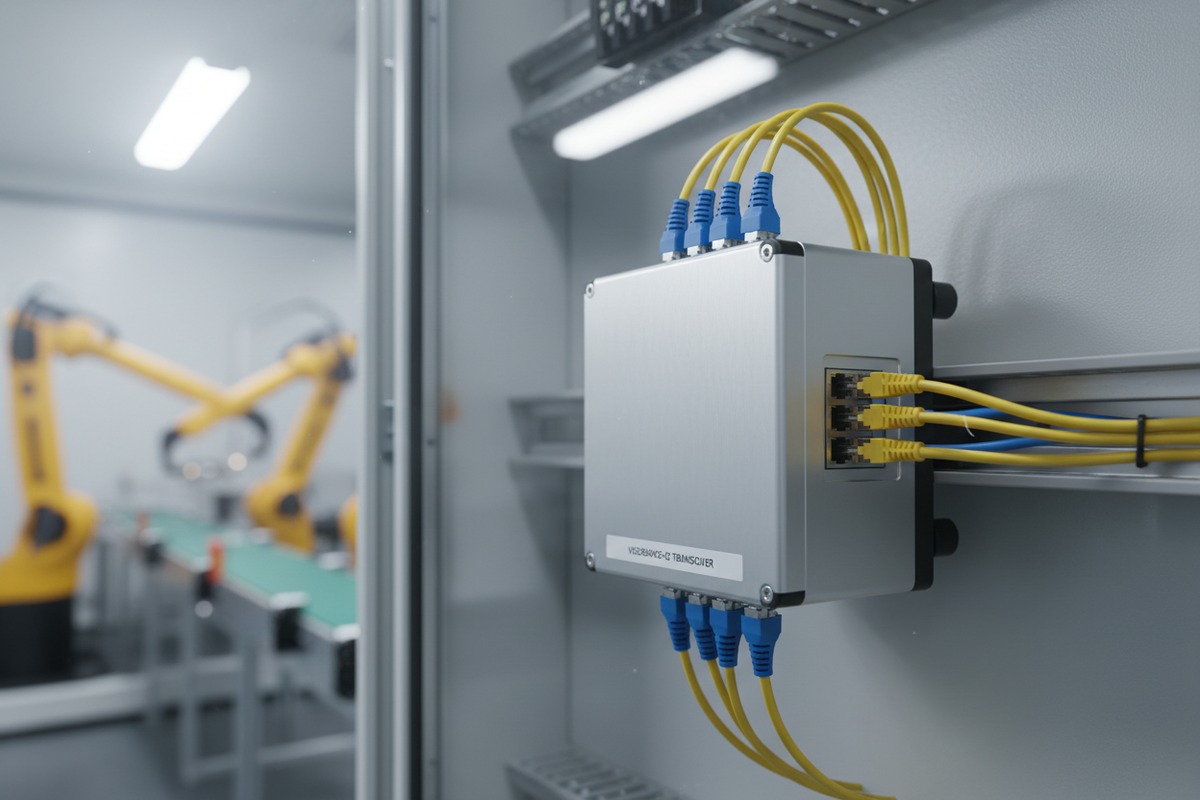
Industrial environments are harsh. Vibration, dust, temperature extremes, and electromagnetic interference (EMI) are constant threats. Meanwhile, Industry 4.0 demands more Ethernet ports in smaller devices — gateways, edge controllers, PLCs, and HMIs all need reliable Gigabit links. Board space inside a DIN-rail enclosure is extremely limited, and thermal dissipation options are often restricted to passive cooling only.
The VSC8504XKS-02 addresses these pain points directly. Four ports in one chip means fewer packages generating heat, less total board area consumed, and a simpler thermal profile.
One of the most relevant trends in industrial networking is Single-Pair Ethernet (SPE) 6. Traditional Ethernet uses four twisted pairs for Gigabit speeds. SPE achieves 100 Mbps (100BASE-T1) or even 1 Gbps (1000BASE-T1) over just one twisted pair. This cuts cable weight, reduces connector size, and lowers installation cost — all critical in automotive production lines, warehouse robotics, and sensor networks.
The VSC8504XKS-02 supports both 100BASE-T1 and 1000BASE-T1 7 standards, aligning it with IEEE 802.3bp and 802.3cg. This makes it a natural fit for new SPE deployments where legacy four-pair cabling is impractical.
An IoT gateway typically aggregates data from multiple field devices and forwards it upstream to a cloud platform or local server. The gateway may need four or more Ethernet ports: one or two for uplink, and the rest for connecting downstream devices. Using a single VSC8504XKS-02 instead of four discrete PHYs simplifies the design dramatically.
| Design Factor | Quad PHY (VSC8504XKS-02) | 4x Discrete Single PHY | Impact |
|---|---|---|---|
| Component count | 1 IC + shared passives | 4 ICs + 4 sets passives | Fewer parts to source |
| PCB footprint | ~1 cm² per port (estimated) | ~4 cm² per port | Fits DIN-rail enclosures |
| Thermal output (idle) | Reduced via EEE | Higher aggregate idle power | Passive cooling feasible |
| SPE support | 100BASE-T1, 1000BASE-T1 | Rarely supported | Future-proof for Industry 4.0 |
| EMI performance | Integrated design, shorter traces | Longer traces, more EMI risk | Better signal integrity |
It is important to note that the VSC8504XKS-02 does not carry explicit AEC-Q100 automotive qualification 8 based on publicly available datasheets. If your industrial project requires formal automotive-grade certification — for example, in-vehicle Ethernet for ADAS or infotainment — you may need to evaluate dedicated automotive PHYs such as NXP’s SJA11xx family. However, for general industrial automation, factory floor gateways, and non-automotive IoT applications, the VSC8504XKS-02 is more than capable.
Another consideration is vendor ecosystem. The VSC8504XKS-02 integrates well with Microchip’s broader product line, including PolarFire SoCs and various switch ICs. This can be an advantage if you already use Microchip components. But if your platform is built around a different vendor’s ecosystem, you should verify driver support and reference design compatibility early in your evaluation.
When we supply PHY components to telecom equipment manufacturers building 5G fronthaul nodes and carrier Ethernet switches, one feature consistently moves to the top of the requirements list: Synchronous Ethernet, or SyncE.
The VSC8504XKS-02 supports Synchronous Ethernet (SyncE) compliant with ITU-T G.8262, enabling carrier-grade frequency synchronization across Ethernet links. This makes it ideal for telecom TDM backhaul, 5G fronthaul/midhaul, and any network infrastructure where precise timing prevents packet loss and service degradation.

Traditional TDM (Time Division Multiplexing) networks inherently carry timing information. When telecom operators migrated to packet-based Ethernet, they lost that built-in synchronization. SyncE restores it by embedding a high-quality clock reference directly into the Ethernet physical layer. This is essential for mobile base stations, where even tiny frequency offsets can cause dropped calls or degraded data throughput.
The VSC8504XKS-02 implements SyncE according to ITU-T G.8262 9, the international standard for synchronous Ethernet equipment clocks. This means it can recover and distribute a traceable timing reference across the network, port by port.
5G networks have dramatically tightened timing requirements. Fronthaul links between radio units and distributed units often need timing accuracy better than ±50 parts per billion (ppb). The VSC8504XKS-02’s SyncE capability, combined with its quad-port density, makes it a strong candidate for small-cell aggregation switches and edge nodes deployed at the base of 5G towers.
Consider a typical small-cell aggregation box. It might need 4 to 8 Ethernet ports facing the radio units and 1 or 2 uplinks to the midhaul network. One or two VSC8504XKS-02 chips handle the radio-facing ports, each providing SyncE-locked timing. The result is a compact, low-power node that meets carrier-grade timing specifications.
A common question is whether SyncE replaces IEEE 1588 Precision Time Protocol (PTP). It does not. SyncE provides frequency synchronization at the physical layer. PTP provides phase and time-of-day synchronization at the packet layer. Modern telecom networks use both simultaneously for maximum accuracy. The VSC8504XKS-02 handles the SyncE side. PTP is typically handled by the MAC or a dedicated timing processor upstream.
Telecom equipment must pass rigorous testing before deployment. The VSC8504XKS-02 includes a built-in Ethernet Packet Generator, which allows in-system production testing and system-level debugging without external test equipment. For telecom OEMs, this reduces test fixture costs and accelerates time-to-market.
| Telecom Feature | VSC8504XKS-02 | Typical Consumer-Grade PHY | Relevance |
|---|---|---|---|
| SyncE (ITU-T G.8262) | Yes | No | Carrier-grade timing |
| Quad-port density | Yes | Typically single-port | Edge node compactness |
| Built-in packet generator | Yes | No | Production testing |
| EEE (802.3az) | Yes | Sometimes | Power savings at cell sites |
| Dual-media support | Yes (Cu/Fiber) | Copper only | Flexible uplink options |
One valid criticism of EEE in telecom contexts is that transitioning between low-power and active states can introduce microsecond-level latency spikes. In ultra-low-latency applications like high-frequency trading or real-time HPC clusters, this could be unacceptable. However, for telecom backhaul and fronthaul, where typical latency budgets are in the hundreds of microseconds to low milliseconds range, EEE latency is well within tolerance. Most implementations also allow EEE to be disabled on a per-port basis if needed.
On our sourcing desk, we handle long-term supply agreements for OEM and ODM clients who cannot afford component discontinuation or batch inconsistency mid-production — and the VSC8504XKS-02 consistently ranks among our most stable Ethernet PHY offerings.
Yes, the VSC8504XKS-02 is well-suited for long-term OEM/ODM manufacturing. Microchip Technology’s strong product longevity track record, broad distributor availability through Mouser and Arrow, competitive volume pricing estimated at $10–20 per port, and integration with Microchip’s wider ecosystem make it a dependable choice for multi-year production programs.

For OEM/ODM manufacturers, nothing is worse than a mid-lifecycle component going end-of-life (EOL). Redesigning a PCB around a new PHY chip can cost tens of thousands of dollars in engineering time and delay product launches by months. Microchip Technology has a well-documented commitment to long product lifecycles, often supporting parts for 10–15 years after initial release. This gives OEM customers confidence that the VSC8504XKS-02 will remain available throughout their product’s market life.
From our warehouse operations in APAC|Hong Kong, we maintain buffer stock of the VSC8504XKS-02 specifically to support customers with quarterly or annual procurement schedules. We source through authorized channels and maintain full traceability documentation — critical for OEM clients who require auditable supply chains.
A recurring pain point we hear from hardware manufacturers is batch-to-batch variation. A PHY chip that performs perfectly in the engineering sample phase but shows different characteristics in production lots can cause costly rework. Microchip’s manufacturing processes are well-controlled, and the VSC8504XKS-02 benefits from mature silicon processes. Still, we recommend that OEM clients request date code alignment for large production runs and perform incoming quality checks on critical parameters like jitter and power consumption.
At the component level, the VSC8504XKS-02 is available through major distributors at volume pricing that translates to roughly $10–20 per Gigabit port, depending on order quantity and market conditions. For a 48-port switch design, the PHY layer cost using 12 units of VSC8504XKS-02 becomes highly competitive versus using 48 discrete PHYs or higher-cost integrated switch ASICs.
Microchip’s ecosystem extends beyond the PHY. Their PolarFire FPGAs, LAN9xxx switch ICs, and various timing devices are designed to work together. For an OEM building a complete networking product, this means validated reference designs, tested interoperability, and single-vendor technical support. It is a genuine advantage during the design-in phase.
However, ecosystem convenience can become a constraint if you later need to switch to a different vendor’s MAC or switch ASIC. We advise OEM clients to verify QSGMII interoperability with their chosen MAC chip early in the design cycle, regardless of vendor.
For cost-sensitive designs where SyncE and advanced EEE features are not required, alternatives like Realtek’s RTL8218D offer lower per-port pricing. However, these lack carrier-grade timing support and may not match the VSC8504XKS-02’s power efficiency profile. The choice depends on your product’s target market: if you are building carrier or enterprise-grade equipment, the Microchip part justifies its premium. If you are building low-cost consumer switches, the Realtek option may suffice.
The VSC8504XKS-02 delivers proven value across enterprise switching, industrial IoT, telecom timing, and OEM/ODM manufacturing — and our team at ITPARTSUPPLY is ready to support your procurement with original stock, batch traceability, and reliable lead times.
1. Explains the fundamental role and function of an Ethernet PHY. ↩︎
2. Replaced with Wikipedia entry for a general, authoritative explanation of QSGMII within media-independent interfaces. ↩︎
3. Replaced with the official IEEE Standards Association page for the 802.3az standard, the most authoritative source available. ↩︎
4. Provides a comprehensive overview of enterprise network switches. ↩︎
5. Replaced with Wikipedia entry for a comprehensive and authoritative overview of Energy Efficient Ethernet. ↩︎
6. Provides a general overview of Single-Pair Ethernet technology. ↩︎
7. Explains the automotive Ethernet standards 100BASE-T1 and 1000BASE-T1. ↩︎
8. Defines the AEC-Q100 standard for automotive integrated circuits. ↩︎
9. Links to the official ITU-T standard for synchronous Ethernet equipment clocks. ↩︎
10. Replaced with Wikipedia entry for a general and authoritative overview of Synchronous Ethernet. ↩︎